Primetime Movie Spoilers: What Happened to Dan Plumb? Ending Explained
I walked into Primetime expecting another Robert Pattinson fireworks show. I walked out thinking about a kid named Dan.
Lance Oppenheim’s jump from documentary work (Some Kind of Heaven, if you haven’t seen it, fix that) into narrative filmmaking could’ve easily been a vanity project built entirely around Pattinson’s live-wire Chris Hansen impression. And look — Pattinson is doing something feral and specific with that role, all fake sincerity and camera-ready menace. But the movie’s actual pulse belongs to Skyler Gisondo, playing a decoy actor named Dan Plumb, and it’s Gisondo’s performance that’s going to stay with people long after they’ve forgotten Pattinson’s line readings.
Here’s the thing nobody tells you going in: Primetime isn’t really about To Catch a Predator. It’s about what that show did to the disposable people standing just outside the frame.
So Who Is Dan Plumb, Actually?
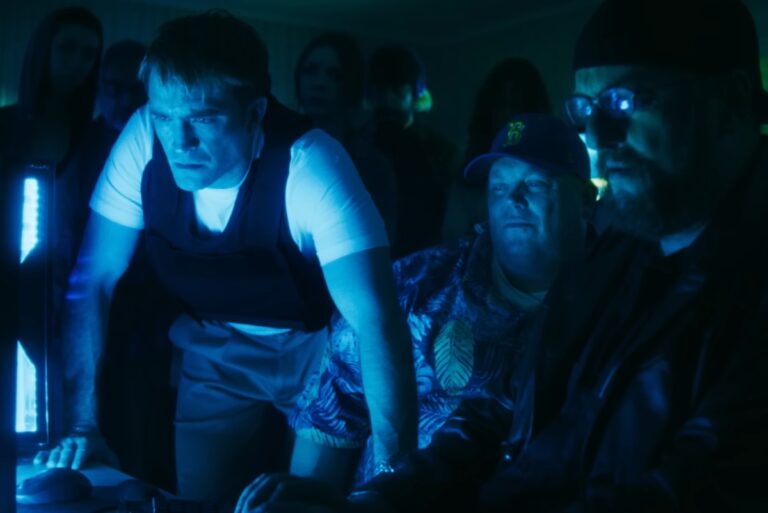
Strip away the neon-noir dressing and Dan starts as the most familiar type in American cinema — the broke, hopeful actor. Twenty-three, chasing a SAG card like it’s a religious relic, taking whatever gig pays. He thinks he’s booked a normal job. What he’s actually signed up for is playing a thirteen-year-old boy in sting houses designed to lure adult men into handcuffs on live television.

That premise alone should feel absurd. It does, for about twenty minutes. Then Oppenheim starts tightening the screws.
What got me was how slowly Dan’s moral compass gets sanded down. There’s no single corrupting moment — no villain monologue, no “sell your soul” contract signing. It’s just Chris Hansen occasionally being warm to him (“You remind me of my son” — a line that’s doing so much quiet, awful work), and Dan mistaking proximity to fame for actual approval. Merritt Wever’s producer character, Andie Bender, is the invented composite here, and she’s terrific as the calculating adult in the room who never once treats Dan like a person with a limit.
By the film’s midpoint, “Dan Plumb, aspiring actor” has fully dissolved into “Decoy Dan,” a guy who’s disturbingly good at manipulating strangers into a trap. And the movie never lets you forget that being good at this is the tragedy, not the triumph.
The Texas Sting: Where Entertainment Stops Being a Metaphor
There’s a structural pivot in the back half of the film that a lot of Letterboxd reviews are calling the “primetime turn,” and it’s the moment the movie stops being clever and starts being sick to its stomach.
The show gets bumped to a real primetime slot, going head-to-head with something as culturally massive as Lost was in the mid-2000s. Ratings pressure does what ratings pressure always does — it pushes everyone toward recklessness. Hansen stops wanting what he calls “bottom feeders” and wants a name. A target with something to lose.
That hunt leads the crew to Murphy, Texas, chasing a lead from an amateur predator-hunter named Xavier (Matthew Maher, doing a lot with a small, unsettling role). The target: a sitting Assistant District Attorney.
He never shows up to the sting house.

Instead of calling it, Hansen does something the film frames as the true point of no return — he takes the cameras, the crew, and the police straight to the man’s home. What follows isn’t staged, isn’t edited for suspense, isn’t a TV beat at all. It’s just a man taking his own life before anyone can say a word to him on camera.
I’ve seen a few reviews call this scene “the moment the movie earns its seriousness.” I’d go further — it’s the moment the film indicts its own genre. Hansen cries, but Oppenheim’s camera doesn’t let you read it as grief. It reads as a man realizing his format just legally detonated. Dan, meanwhile, is just standing there. Watching the actual, unrecoverable cost of something he helped build.
What Actually Happens to Dan by the End
This is the part people are searching for, so here it is straight:
- Dan never returns to acting in any meaningful way after the Texas sting
- The film jumps forward one year, relocating him to a modest, anonymous life in Mesa, Arizona
- He’s living quietly, deliberately far from Hollywood, from cameras, from Hansen’s orbit entirely
- A neighbor drops off misdelivered mail — inside is Dan’s official SAG-AFTRA union card
- He’d technically logged enough professional hours on the show to finally qualify
- The final shot holds on his face as he looks at it: not joy, not relief — something closer to a bruise finally scarring over
That closing image is doing brutal, elegant work. Dan spends the entire film chasing legitimacy in an industry, and he gets it — but only as a byproduct of the exact experience that broke him. The smile the script gives him isn’t triumphant. It’s the smile of someone who’s stopped expecting things to make sense.
| What Dan Wanted | What Dan Got | The Cost |
|---|---|---|
| A SAG-AFTRA card | The card, eventually | His sense of moral certainty |
| Validation from an industry he admired | Validation from Chris Hansen | A front-row seat to a man’s death |
| A career | A quiet life in Arizona, away from cameras | Every relationship tied to Hollywood |
He’s a Real Person — And His Actual Story Is Quieter Than the Movie’s
Here’s where Primetime stops being invention and starts being reportage with a filter on it. Dan Plumb is a lightly fictionalized version of a real decoy, Dan Schrack, who genuinely worked the original To Catch a Predator set, credited across seven episodes, including the real Murphy, Texas sting that ended with Assistant District Attorney Bill Conradt taking his own life in November 2006 as police entered his home.
That real event produced everything you’d expect from a media catastrophe of that scale — a wrongful death lawsuit from Conradt’s sister against NBC, Luke Dittrich’s genuinely essential Esquire piece “Tonight on Dateline This Man Will Die” (read it if the movie hooks you), and eventually the show’s cancellation.
What the film gets right, quietly, is the aftermath. The real Schrack didn’t chase Hollywood after that. He walked toward something steadier — local news. He worked his way through newsrooms in Buffalo and Elmira before landing at Rochester’s 13WHAM in 2019, where he’s built an actual, sustainable career in broadcast journalism, about as far from reality-TV sting operations as you can get while staying in front of a camera.
There’s something almost unbearably fitting about that. The man who once played a fictional teenager to catch real predators eventually became someone whose entire job is telling people the truth, on the record, with his own name attached.
Primetime Movie True Story: Everything A24 and Robert Pattinson Changed vs Real Life
Why This Is the Character People Are Actually Talking About
Every Reddit thread on r/A24 I’ve scrolled through lands on the same realization: you go in for Hansen, you leave thinking about Dan. That’s not an accident — it’s the movie’s whole argument. Hansen never changes. He stays locked inside his own myth from frame one to the credits, a man who mistook a TV format for a moral crusade and never once looked back.
Dan is the only person in Primetime who actually pays for what happened — not with prison, not with a lawsuit, but with the quiet, permanent erosion of who he thought he was becoming. Gisondo plays that erosion without a single big speech, just a slow dimming behind the eyes that critics keep describing, accurately, as the moment “the light of innate decency switches off.”
That’s a hell of a thing for a movie ostensibly about a cable news personality to actually be about.