The Rivals of Amziah King Ending Twist Explained: Decoding Andrew Patterson’s Neo-Western Noir
There are movies that tell you exactly what kind of story they are within the first ten minutes. The Rivals of Amziah King is not one of them.
Andrew Patterson, the filmmaker behind The Vast of Night, seems almost allergic to giving the audience the comfortable version of a story. I felt that immediately here. At first, this looks like a strange, funny, deeply regional character piece about Amziah King, a bluegrass-playing beekeeper who has somehow become the unofficial glue holding a small Oklahoma community together. Then the movie makes a choice that completely changes the experience.
And honestly, that choice is what makes the film stick with me.
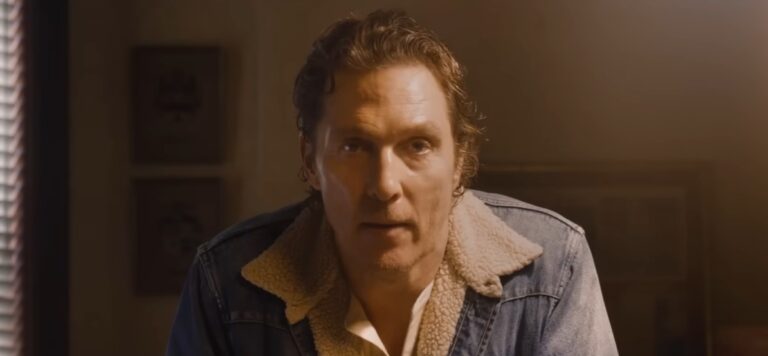
Matthew McConaughey’s Amziah feels like the protagonist you expect to follow all the way to the credits. He has the personality, the history, the community connections, and the kind of larger-than-life presence that usually screams “this is our guy.” But Patterson isn’t interested in giving him the conventional hero’s journey. Instead, The Rivals of Amziah King quietly builds a story about what happens when the person holding a community together disappears — and someone else has to decide how far she is willing to go to keep it alive.
That someone is Kateri.
Amziah King Isn’t Really the Story’s Final Hero
The first half deliberately makes Amziah look like the center of everything.
He is a beekeeper, musician, businessman, Christian, foster father, and community fixer rolled into one. McConaughey plays him with that relaxed Southern charisma he has used so effectively in other roles, but there is something slightly sad underneath it. Amziah genuinely believes that people can be saved through connection.

His honey operation is more than a business. It becomes a miniature version of his entire philosophy.
The hives survive because everything is connected. Workers have their roles. The queen gives the colony direction. Remove the queen and the structure begins to collapse.
That idea becomes much more important later.
When Kateri returns to Amziah’s life, she isn’t simply another character being introduced into his world. She is someone who understands the darker side of survival. Her childhood has taught her that people don’t always behave because they’re good. Sometimes they behave because they’re afraid, desperate, or forced into a corner.
Amziah tries to show her another way.
Their relationship is one of the strongest elements of the movie because neither character is completely wrong.
Amziah understands how communities are built.
Kateri understands how they can be destroyed.
And the film eventually forces Kateri to combine those two lessons.
The Honey Business Is Really a Crime Story in Disguise
One of the weirdest things about The Rivals of Amziah King is how seriously it treats honey.
A shipment worth roughly $250,000 disappears, barrels are found abandoned, beekeepers are pushed around, and the local honey industry starts looking less like a rural business network and more like a criminal organization.
I actually love this aspect of the movie because Patterson never feels the need to explain why honey has suddenly become this high-stakes commodity. He simply commits to the idea.
The result is almost a rural noir where the weapons are replaced by bee colonies, supply chains, agricultural permits, and intimidation.
But underneath that unusual setup is a familiar story: small independent operators being crushed by someone with more money, influence, and muscle.
That is where Dob McCoy enters the picture.
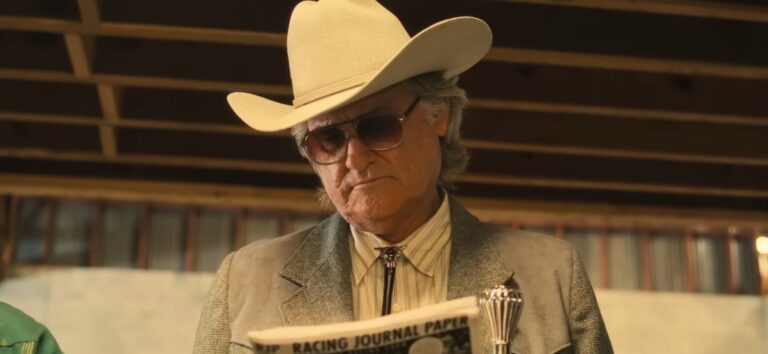
Played by Kurt Russell, McCoy doesn’t need to behave like a cartoon villain. His power comes from being frighteningly practical. He sees the local honey producers as obstacles and resources rather than human beings.
That makes him a perfect opponent for Kateri.
The Movie’s Biggest Shock: Amziah Steps Aside
This is the moment I think audiences will either love or fight with.
Around the middle of the film, Amziah effectively disappears from the story’s center.
Not in the usual “hero goes missing and returns for the third act” way. Patterson actually hands the movie over to Kateri.
That is a huge gamble.
For an hour, we’re trained to watch McConaughey. His voice, humor, music, relationships, and presence dominate the movie. Then suddenly, the rhythm changes. The soundtrack feels different. The storytelling becomes colder. Kateri starts moving through the world with a completely different energy.
It reminded me of the kind of structural confidence that made Psycho so memorable. The point isn’t simply that the story changes. The audience’s expectations change with it.
And suddenly the title The Rivals of Amziah King feels almost deliberately misleading.
This isn’t ultimately a story about Amziah defeating his rivals.
It’s about what his absence forces Kateri to become.
Kateri’s Transformation Is the Real Ending Twist
Kateri begins the film as someone trying to find her place in a world she doesn’t entirely trust.
By the second half, she has stopped asking whether people deserve mercy.
She’s asking what has to be done.
That distinction matters.
Amziah’s philosophy is based on the belief that damaged people can still belong. Kateri doesn’t reject that idea completely. In fact, protecting that community becomes her motivation. But she realizes something Amziah never fully accepts: some predators don’t want to join the hive. They want to control it.

So Kateri starts playing a different game.
She uses an assumed identity, investigates the agricultural operation from the inside, and works with people who can help her uncover what is happening. Her methods become increasingly calculated.
There is no grand superhero transformation.
That’s what makes it unsettling.
Kateri simply becomes more comfortable doing things Amziah would never do.
The contrast between them is basically the film’s moral engine:
| Amziah King | Kateri |
|---|---|
| Community first | Survival first |
| Forgiveness | Consequences |
| Faith in people | Suspicion of people |
| Open and charismatic | Quiet and guarded |
| Avoids violence | Accepts violence when necessary |
| Protects the hive through connection | Protects the hive through force |
Dob McCoy Forces Kateri Across the Line
Kurt Russell’s Dob McCoy represents everything Kateri has learned to distrust.
He doesn’t care about the community’s emotional ties or the history between families. He understands power, money, and leverage. The independent beekeepers aren’t neighbors to him. They’re competition.
The more Kateri uncovers, the clearer it becomes that ordinary methods aren’t going to solve the problem.
And this is where the ending becomes much more interesting than a standard revenge story.
Kateri doesn’t simply defeat McCoy because she is stronger.
She defeats him because she is willing to become something he doesn’t expect.
She stops pretending that the system will save these people.
She stops waiting for someone else to intervene.
And she takes control.
What the Ending Twist Actually Means
The violence at the end matters, but the deeper twist isn’t simply who survives.
It’s what Kateri has to sacrifice to make survival possible.
She dismantles McCoy’s operation and helps secure the future of the local community. On the surface, that’s a victory. The people are safe. The stolen resources are recovered. The threat is gone.
But Kateri knows exactly what happened behind that victory.
The people around her don’t.
That’s the uncomfortable part.
The community gets to keep its music, church gatherings, food, friendships, and ordinary routines because someone else dealt with the ugliness outside their view.
And that someone is Kateri.
The woman who was once being taught how to care for the hive has become its protector.
But she no longer protects it in the same way Amziah would.
Why the Queen Bee Metaphor Is So Important
That early scene with Kateri and the bees becomes almost painfully obvious once you reach the ending.
Amziah explains how the colony protects its queen. The bees gather around her because the survival of the entire hive depends on her.
At the time, it feels like a charming lesson.
Later, it becomes a blueprint.
Kateri essentially becomes the new queen.
Not because she replaces Amziah as a warm community leader, but because she becomes the person willing to make decisions that everyone else can avoid.
That gives the final image its uncomfortable power.
She has saved the hive.
But she has also separated herself from it.
Is The Rivals of Amziah King on Netflix? How to Watch Matthew McConaughey’s 2026 Movie Online
The Final Shot Isn’t a Happy Ending
The community gathering near the end could easily have been filmed as a victory lap.
Instead, it feels strangely uneasy.
Everyone else can breathe again.
They can eat together. Talk together. Return to their routines.
Kateri is there, but emotionally she seems somewhere else.
That expression matters more than any final explanation could.
She has accomplished exactly what she set out to do, yet she cannot simply return to being the person she was before.
And I think that is the real sting of the ending.
Kateri wins the external battle but loses her innocence in the process.
There is no magical restoration. No moment where Amziah’s worldview suddenly proves completely correct. No punishment that neatly balances the moral equation.
The film leaves us sitting with the uncomfortable possibility that sometimes a peaceful community survives because somebody outside the peaceful circle is willing to do terrible things.
That’s a much uglier idea than the usual “good defeats evil” ending.
It’s also much more interesting.
Why the Ending Feels So Bittersweet
What stayed with me after the final scene wasn’t Dob McCoy.
It was Kateri watching everyone else continue their lives.
That’s the whole movie in miniature.
Amziah wanted to build a world where people could protect one another without becoming monsters. Kateri discovers that the world isn’t always willing to cooperate with that dream.
So she protects it anyway.
Just differently.
The film’s title ultimately becomes another little trick. The rivals aren’t simply businessmen fighting over honey. The real conflict is between two ideas of what it means to protect the people you love.
Amziah believes the hive survives through compassion. Kateri learns that sometimes compassion needs someone willing to stand outside the hive and face the predators.
That doesn’t make her a hero in the traditional sense.
It makes her something much sadder.
A protector who can no longer pretend she is innocent.
And that’s why the ending of The Rivals of Amziah King works for me. It doesn’t give Kateri a clean reward for doing the right thing. It gives her something closer to responsibility. The community survives, but she has to carry the knowledge of what survival cost.
For a movie that begins with banjo music, honeybees, church, and a larger-than-life Oklahoma character played by Matthew McConaughey, that’s a surprisingly dark place to leave us.
But Patterson has been preparing us for it from the beginning.
The queen was never just about the bees.
It was always about who would protect the hive when Amziah couldn’t.