The Rivals of Amziah King Ending Explained: The Shocking Genre Shift and 2026 Movie Review
There are movies you wait for because the premise sounds good. Then there are movies you wait for because you genuinely have no idea what the director is going to do with them. The Rivals of Amziah King belongs firmly in the second category for me.
I have had Andrew Patterson’s name on my watchlist ever since The Vast of Night. That film had such a strange confidence to it, especially for a filmmaker working with relatively modest resources, that I was curious about whatever Patterson would attempt next. So when The Rivals of Amziah King started generating buzz after SXSW, I was already sold.
What I didn’t expect was a movie that practically changes its identity halfway through.
At first, this looks like a warm, eccentric rural character piece about beekeeping, bluegrass, faith, grief, and a man who seems to know practically everyone in his corner of Oklahoma. Then, without much warning, it starts moving toward crime, revenge, corporate corruption, and outlaw justice.
And somehow, the bees remain at the center of it all.
A Matthew McConaughey Performance That Hooks You Immediately
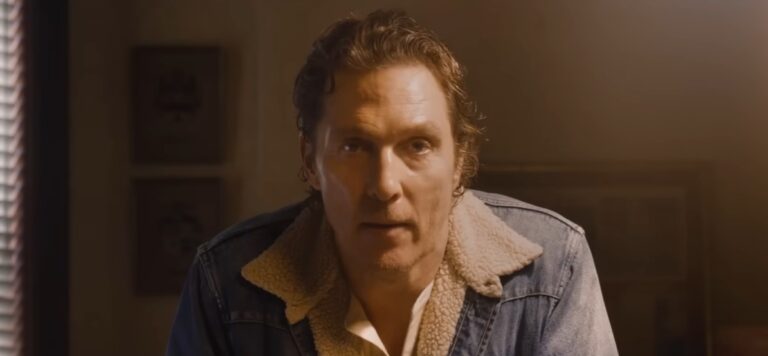
Matthew McConaughey plays Amziah King, and this is exactly the kind of role that feels tailor-made for him.

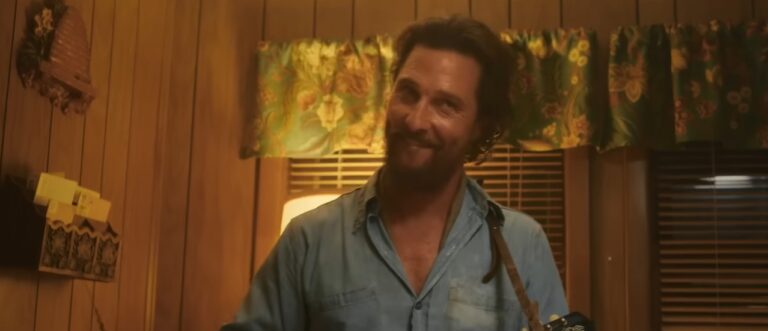
Amziah is a beekeeper, musician, community fixture, and deeply religious man with an almost disarming warmth. He’s the sort of guy who can walk into a diner and immediately feel like he has known everybody there for twenty years. He plays mandolin, runs a successful honey operation, organizes community gatherings, and carries himself with an unusual mixture of confidence and humility.
There is also something slightly sad underneath all that charm.
Amziah has already experienced loss. His wife Glenda is gone, and the years they spent caring for foster children are part of the emotional history he carries around with him. That becomes especially important when Kateri, one of those former foster children, unexpectedly comes back into his life.
Kateri isn’t the wide-eyed kid Amziah remembers. She’s older, guarded, skeptical, and clearly carrying her own damage.
Their reunion gives the movie its strongest emotional foundation.
Amziah doesn’t simply welcome her back. He starts teaching her the things he knows, including the craft that has defined his life. The beekeeping scenes aren’t just there for atmosphere, either. Patterson uses the hive as a quiet piece of storytelling.
Amziah explains how the queen holds the colony together.
At first, it sounds like another charming bit of rural wisdom.
Later, it becomes the key to understanding the entire movie.
The First Hour Feels Like a Completely Different Film
This is where The Rivals of Amziah King gets really interesting.
For roughly the first half, I was watching a laid-back Oklahoma drama with flashes of comedy and music. The film takes its time. It lets conversations breathe. It spends time around the community rather than rushing toward the next plot point.
There are church gatherings, bluegrass performances, honey production, eccentric locals, and plenty of small details about Amziah’s everyday life.
Then Patterson starts pulling those threads apart.
A strange case involving abandoned honey barrels leads Amziah toward a much darker side of the local agricultural business. What initially seems like a bizarre isolated incident turns out to be connected to a much larger criminal operation.
And then the movie gets violent.
Not gradually. Not politely.
One particularly nasty industrial accident makes it clear that Patterson has stopped playing by the rules established during the first hour. Soon afterward, Amziah’s honey operation is attacked and his bees are stolen.
That is the moment when the movie effectively changes protagonists.
McConaughey, who has been the unmistakable center of the story, starts disappearing from the foreground.
Kateri takes over.
I can imagine this being incredibly frustrating for some viewers. If you came for a Matthew McConaughey-led rural drama, suddenly watching the film transform into a revenge thriller is one hell of a bait-and-switch.
Personally, I loved the nerve of it.
Kateri Becomes the Movie’s Real Protagonist
Angelina LookingGlass gives Kateri a remarkably controlled performance, especially considering how much the character has to carry once the story changes direction.
She isn’t suddenly transformed into an action hero. That’s what makes her progression work.
Kateri is observant. She watches people. She doesn’t trust easily. She has spent much of her life learning how to survive rather than how to belong.
That makes Amziah’s influence particularly important.
After his business is attacked, Kateri begins fighting to protect the community he built. She doesn’t do it alone. Amziah’s friends, employees, musicians, and other members of his extended circle become part of the operation.
The movie starts resembling a strange combination of Southern noir, Western revenge story, agricultural crime thriller, and heist movie.
It’s a bizarre mixture.

Yet the first half quietly prepared us for it.
The community that seemed quaint earlier suddenly becomes an organized network of people who know each other, trust each other, and are willing to take risks when one of their own is threatened.
Who Is the Real Villain?
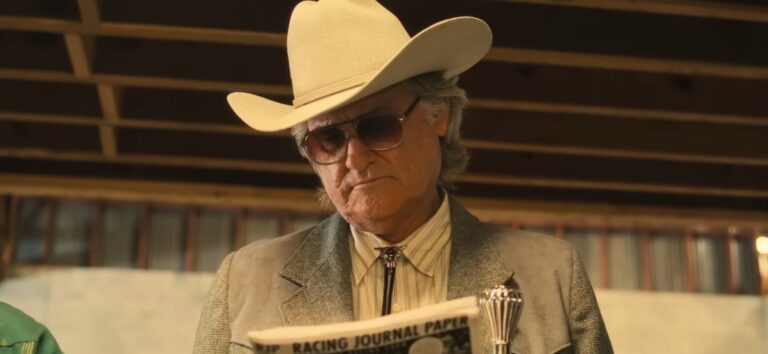
Enter Dob McCoy, played by Kurt Russell.
McCoy represents almost everything Amziah’s world rejects. He’s powerful, wealthy, ruthless, and connected to the corporate machinery that has squeezed independent producers out of the market.
The conflict isn’t simply good guy versus bad guy.
It’s about two completely different ideas of how a community should function.
Amziah’s world is built around relationships. McCoy’s is built around control.
Kateri eventually goes undercover, posing as an investigator connected to the state agriculture commission. From there, the movie becomes a cat-and-mouse game involving deception, stolen honey, corporate operations, and increasingly elaborate retaliation.
Some of these sequences are wonderfully scruffy. They don’t have the polished feeling of a conventional Hollywood crime thriller. People improvise. Plans go wrong. Characters rely on what they know rather than some perfectly executed master plan.
That fits the movie.
The Ending Explained: Kateri Becomes the New Queen
The ending makes much more sense once you go back to Amziah’s early lesson about the hive.
A colony needs its queen.
Without that central figure, the structure eventually collapses.
At the beginning, Amziah is the queen bee of his little world, even if the metaphor isn’t immediately obvious. He’s the person holding everyone together. He’s the emotional center, the provider, the teacher, and the community’s unofficial leader.
When his world is attacked, Kateri gradually assumes that role.
Her final actions against McCoy aren’t simply about revenge for stolen honey or damaged property. She’s protecting the community Amziah created.
The climax avoids the neatness of a traditional action movie. Instead of ending with a perfectly staged gunfight and an obvious victory, Kateri and Amziah’s allies use a combination of deception, sabotage, and carefully planned operations to strike back at McCoy’s infrastructure.
His criminal activities are exposed, his operations are disrupted, and the stolen resources are recovered.
But Patterson doesn’t pretend that winning fixes everything.
Kateri has crossed lines she probably never imagined crossing. She has lied, manipulated people, participated in dangerous schemes, and embraced violence because the circumstances demanded it.
She wins.
But she doesn’t walk away untouched.
That distinction is important.
The final moments return to the community itself. The people who surrounded Amziah remain together, and the sense of belonging he created survives.
The man may no longer be at the center of the story.
His philosophy is.
And Kateri is now the one carrying it forward.
Why the Genre Switch Actually Works
The biggest risk in The Rivals of Amziah King is also its biggest strength.
The genre shift is enormous.
- Rural character drama
- Bluegrass and community storytelling
- Beekeeping and family themes
- Southern comedy
Then the film turns into:
- Neo-noir crime
- Revenge thriller
- Undercover investigation
- Western-style outlaw justice
That shouldn’t work as well as it does.
But Patterson plants enough thematic material in the opening section that the second half feels less like a completely unrelated movie and more like a darker interpretation of what we already watched.
The hive metaphor is the glue.
So is the idea of community.
The first half tells us why these people matter to each other. The second half asks what they are willing to do to protect that connection.
That is a much more interesting question than simply asking whether Kateri will get revenge.
The Best Parts of the Movie
For me, the obvious standout is McConaughey. He brings an almost mischievous spirituality to Amziah. There is nothing particularly subtle about the character, but McConaughey understands exactly how far to push him without turning him into a caricature.
The chemistry with LookingGlass is also crucial. Their relationship gives the movie a heartbeat before everything becomes much darker.
Then there is the famous live bee sequence.
Seeing Amziah handle an enormous mass of actual bees is one of those moments that sticks in your head. The fact that the sequence was achieved without digital bees makes it even stranger to watch. It feels almost mythological, which is exactly the tone the film wants.
And I can’t ignore the music.
The bluegrass performances, church scenes, diners, barns, and honey farms create such a specific sense of place that Oklahoma practically becomes another character.
That makes the violence later feel much nastier.
The Rivals of Amziah King Ending Twist Explained: Decoding Andrew Patterson’s Neo-Western Noir
Where the Movie Loses Me
The second half isn’t perfect.
Once Kateri’s undercover operation becomes the main storyline, the movie occasionally gets bogged down in logistics. There are stretches where I wanted the story to move faster, particularly when the investigation starts explaining itself rather than simply letting the characters operate.
The runtime also feels longer than necessary.
At around 130 minutes, there are scenes I enjoyed individually that probably didn’t need to remain in the final cut. Patterson clearly likes atmosphere, lingering close-ups, awkward pauses, and detours into character behavior.
Usually, I’m completely on board with that.
Here, though, the pacing occasionally starts fighting the movie.
There is also the unavoidable issue of McConaughey disappearing from the center of the film. Even though Kateri earns her promotion to protagonist, the movie simply isn’t as charismatic without Amziah around.
That’s not a criticism of LookingGlass.
It’s a testament to how much energy McConaughey brings to the first half.
Final Verdict
The Rivals of Amziah King is messy, strange, funny, violent, and far more ambitious than I expected.
It isn’t the smoothest movie of 2026, and I suspect the abrupt genre change will be a deal-breaker for some people. If you want a straightforward rural drama, this movie will absolutely test your patience.
But if you’re willing to follow Patterson when he suddenly takes the story somewhere completely different, there is a lot to appreciate.
I went into this expecting a Matthew McConaughey-led Southern character piece.
I got that movie for about an hour.
Then I got a revenge thriller about stolen bees, corporate agriculture, community loyalty, undercover schemes, and a young woman realizing that she may have inherited far more from her foster father than a knowledge of beekeeping.
That’s the part I’ll remember.
The Rivals of Amziah King doesn’t just change genres. It changes what the first half means. Once Kateri steps into Amziah’s place, all those earlier conversations about queens, colonies, family, and survival suddenly carry a different weight.
It is an odd movie.
Sometimes an awkward one.
But I’d much rather watch a filmmaker swing this hard and occasionally miss than spend two hours watching something perfectly safe.
And honestly, after waiting this long for Andrew Patterson’s next film, safe was the last thing I wanted.
Rating: 8/10