Never After Dark 2026 Ending Explained: Every Major Plot Spoiler and Twist Revealed
I’ve been chasing J-horror highs since I was way too young to be watching this stuff on scratched-up rental VHS tapes, and I can count on one hand the movies that actually managed to surprise me in the last few years. Never After Dark is one of them. Not because it reinvents the ghost story — it doesn’t, not really — but because it waits. It lets you settle into a rhythm, lets you think you know what kind of movie you’re watching, and then rips the floor out from under you right when you’re comfortable.
Dave Boyle’s film, produced under the fledgling Signal181 label with Kento Kaku wearing both an acting and producing hat, picked up the Grand Jury Prize at Overlook and the Midnighter Audience Award at SXSW, and honestly, both feel earned. It wears its Ringu and Ju-On influences openly — the cold color grading, the domestic dread, the sense that a house can hold onto pain the way skin holds onto a scar — but it bolts a hardboiled detective structure onto that skeleton, and that combination is why the third act lands so hard.
If you just walked out of the theater with your jaw on the floor, or you’re the type who wants the mechanics explained before you press play, here’s the full breakdown — premise, rules, twist, and that maddening final shot.
Never After Dark Where to Watch: Streaming, Theatrical Release, and Digital VOD Guide
Who Is Airi, and Why Does She Talk to Mirrors?
Moeka Hoshi plays Airi, a drifting medium who treats the supernatural like a job because, functionally, it is one. Property owners hire her to clear out lingering hauntings before a house gets flipped or renovated, and she moves through that work with a flat, professional calm. Her whole philosophy, more or less, is that the dead are the easy part of her job — their motives are simple, their pain is legible, and once you understand what a ghost wants, you can usually talk it into moving on.
The living, on the other hand, are a different story. Keep that line in your back pocket. It matters a lot later.
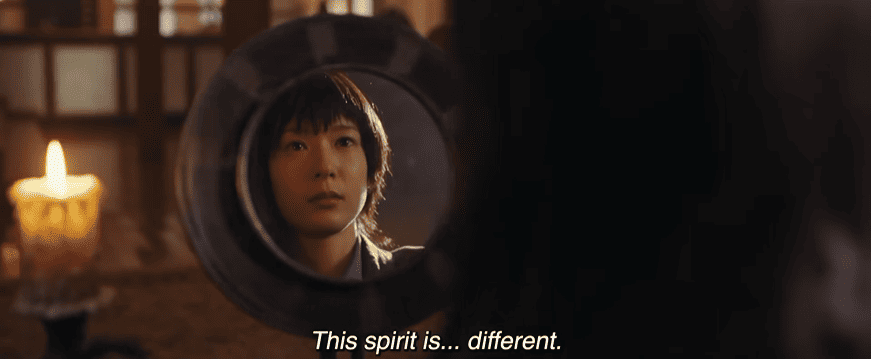
Airi’s only real companion is her younger sister Miku (Kurumi Inagaki) — who died years earlier and now exists as a ghost Airi refuses to let go of. Miku can’t manifest physically. She only shows up in reflections: car mirrors, TV screens, puddles on the pavement. It’s genuinely sweet in places, almost cozy, the two of them bantering like sisters do. But it’s also a quiet horror story of its own — Airi is so tethered to her dead sister that she’s stopped living, and the film makes that literal. Every time she needs to ritually cross into the spirit world, she has to sacrifice a lock of her own hair. Her haircut gets choppier and more asymmetrical as the movie goes on, and you start to wonder, with real dread, what happens when there’s nothing left to cut.
The Hotel, the Broken Clock, and ‘The Gaping Mouth Man’
Airi’s newest job takes her to a remote former hotel being renovated by Teiko Nakazawa (Tae Kimura), who swears something is roaming her halls. Her son Gunji (Kento Kaku) doesn’t buy any of it — until he starts falling for the medium he thinks is running a con.
A few details worth flagging before the plot accelerates:
- The grandfather clock in the hotel’s central room is frozen at 12:00, no matter the actual time — a visual cue that something in this building refuses to move forward.
- Airi’s cardinal rule: rituals only during daylight. Ever.
- Her crossing method: candle, burnt hair, a mirror, and a spinning zoetrope device that hypnotizes her into the blue-tinted netherworld, where ghosts are stuck reliving their worst moments on a loop.
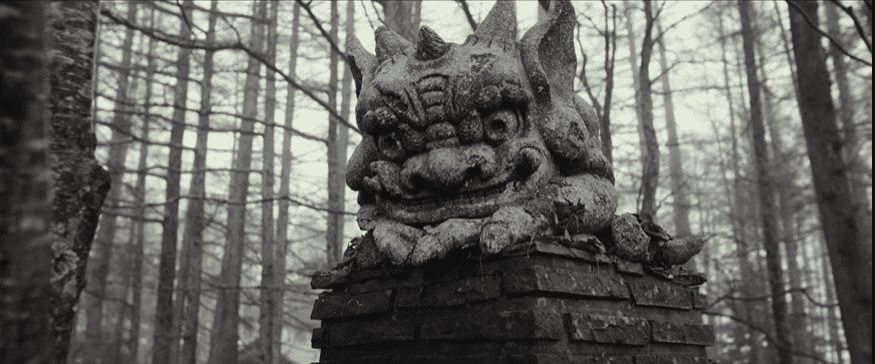
On her first crossing at the hotel, Airi meets an entity the internet has already nicknamed The Gaping Mouth Man — a disfigured male spirit with the lower half of his face torn away, clawing desperately at a locked floor cabinet. When he notices her and grabs her arm, she yanks herself back to reality with an actual bruised handprint burned into her skin. That’s new. That’s not how ghosts are supposed to work. Miku, watching from a reflection, tells her sister flat-out to walk away.
She doesn’t, obviously. She’s a detective at heart, even if her badge is a burnt lock of hair instead of a shield.
The Twist Nobody Saw Coming: This Isn’t a Ghost Story Anymore
Here’s where Never After Dark stops being a haunted-hotel movie and turns into something much nastier. Airi cracks open that floor cabinet and finds human teeth and personal effects belonging to guests who checked in years ago and never checked out.
The film doesn’t dawdle on the reveal: the real threat has never been supernatural. A living serial killer has been using the hotel’s isolation to trap and murder guests for years. The Gaping Mouth Man wasn’t an ancient tragedy — he was one of the killer’s victims, stuck in a loop at his own death site, trying eternally to expose the evidence that would out his murderer.
| What We Assumed | What It Actually Was |
|---|---|
| The frozen clock | A symbol of a trapped, looping death |
| The Gaping Mouth Man | A recent murder victim seeking justice |
| The ‘monster’ | A human being with a weapon |
Airi gets a premonition of Gunji’s murder — and then watches it happen exactly as she saw it, in brutal, practical-effects-heavy detail. Her own rule about fearing the living more than the dead stops being a personality quirk and becomes a prophecy she’s living inside.
The Climax: Breaking Her Own Rule After Dark
Cornered and losing a physical fight she can’t win, Airi does the one thing she’s never allowed herself to do: she performs the ritual after sunset, dragging both her own consciousness and the killer’s across the veil together.
Inside the netherworld, the tables turn hard. The killer is confronted by the metaphysical weight of everyone he’s murdered, and it’s genuinely one of the more satisfying ‘monster becomes the meal’ sequences I’ve seen in recent horror — his own crimes turn on him, tearing into him psychologically and physically. When he tries scrambling back toward the physical candle to snuff the ritual and escape, Airi — bleeding out from real-world wounds — cuts him off and buries an ax directly into his jaw.
And that’s the gut-punch: destroying his mouth in the spirit world is what creates the disfigured ghost she met at the very start of the film. The Gaping Mouth Man wasn’t a relic of the past. He was the killer, trapped in a loop she was always going to cause. Time isn’t linear here — it’s a closed circuit, and Airi was inside it the whole time without knowing.
That Ending Everyone’s Arguing About
The film’s final rule is simple and cruel: a medium stays in the netherworld only as long as the ritual candle stays lit. Let it go out, and you’re yanked back to your body — assuming you have one to go back to.
As Airi lies dying, she crosses over one last time to be with Miku. We cut to the candle. The wax is gone. The flame gutters, dies, and the screen goes black. No wake-up shot. No body. Nothing.
Boyle leaves it split two ways:
- She dies and stays trapped. Bleeding out the exact moment the flame dies means her spirit never fully separates from the netherworld — tragic, but also the one thing she’s always wanted: to be with Miku permanently, no mirror in between.
- She survives, but wrong. Altered, hollowed out, existing in some blurred state where living and dead have stopped meaning much of anything to her.
Personally? I think the film wants both readings sitting in your chest at once — that’s the whole point of cutting to black instead of answering. The real thesis here isn’t ‘ghosts are scary.’ It’s that the ghosts we choose to carry can be gentler company than the living people standing right next to us, and that’s a much colder thought to walk out of the theater with.